
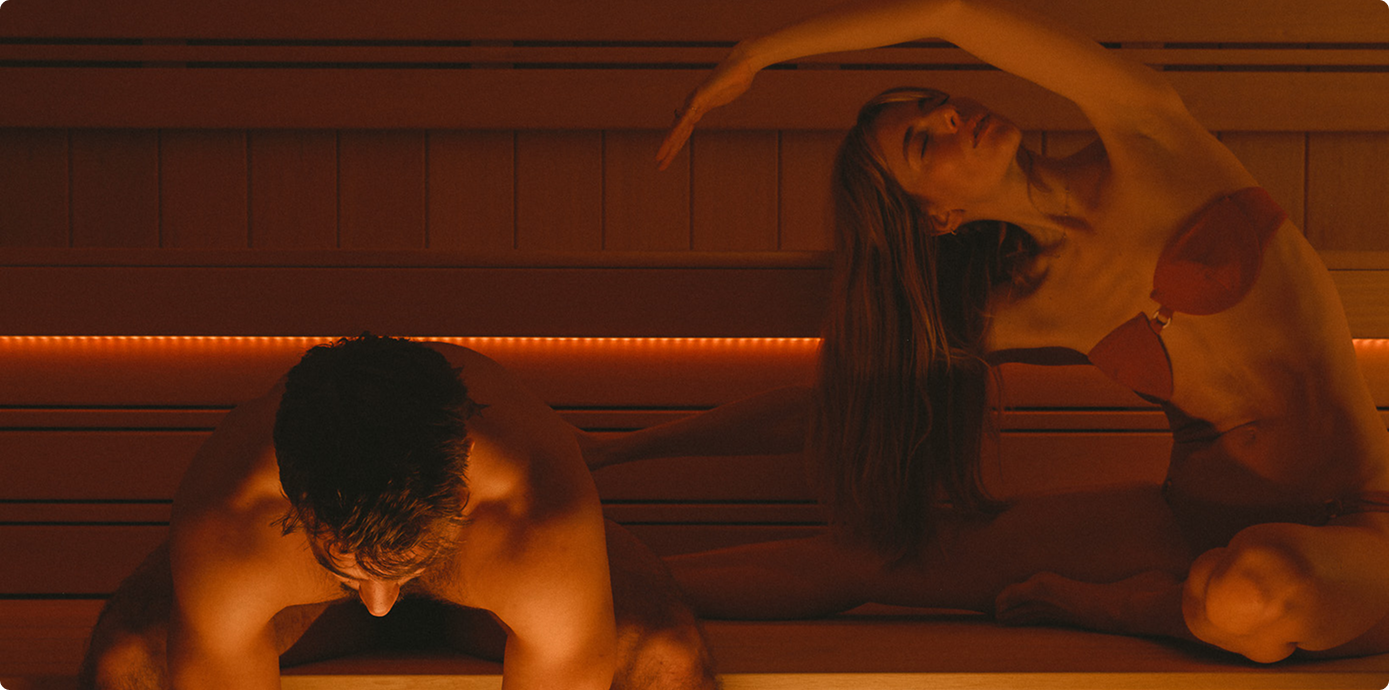
The sauna is no longer confined to hotel complexes or fitness clubs. In Paris, the offering has diversified: Finnish sauna, infrared, hammam, hybrid clubs integrating the cold plunge. Choosing can get complicated.
Not all saunas are equal, and the confusion between "sauna" and "hammam" remains common. Temperature, humidity, duration and format completely change the physiological effects you're after.
This guide walks through the Paris options, the criteria that really matter, and explains why we built RE-SET around a traditional Finnish sauna integrated into a contrast therapy protocol.
Sauna in Paris: what you need to know
Sauna practice in Paris has gone through two phases. For a long time, it was confined to high-end spas and premium fitness clubs, as a complement to other treatments.
Since 2022, a new wave of venues dedicated to functional wellness has arrived; places designed around the sauna and the cold plunge, with a precise protocol.
Today, the Paris offering falls into four main categories:
- Dedicated wellness clubs, venues designed around the sauna and cold plunge, with coaching.
- Premium spas, a sauna offered as a complement to a broad treatment menu.
- High-end gyms, a sauna built into a wellness area, accessed through a membership.Specialized studios, focused on one specific format, often infrared.
The choice depends on what you're coming for: recovery, detox, a regular ritual, a guided experience.
The 4 types of sauna and their differences
Before choosing where to go, you need to understand what you're choosing. The four main formats don't produce the same physiological effects.
- The traditional Finnish sauna
Temperature between 80 and 100 °C, low humidity (10-20%). Intense dry heat. The historic format, originating in Finland, where it has been practiced for over 2,000 years. It's the sauna that triggers the most complete physiological response: deep vasodilation, elevated heart rate, intense sweating, endorphin release.It's also the format backed by the most solid scientific studies, notably the Finnish study of 2,315 men followed for 20 years, which showed reduced cardiovascular mortality in regular users. - The infrared sauna
Temperature between 50 and 60 °C, no humidity. Infrared waves heat the body directly rather than the ambient air. The sensation is less intense, but sweating can be substantial.Its physiological effectiveness is debated in the scientific literature. The cardiovascular and recovery effects are less documented than for the traditional sauna. An interesting format for people who struggle with high heat. - The hammam
Temperature around 45 °C, but 100% humidity. The perceived heat is very different, the steam prevents effective sweating, and the effect is more relaxing than physiological. Excellent for the skin and for unwinding, less so for athletic recovery or the cardiovascular system.Note: a hammam is not a sauna. The two practices are often confused, but their effects are distinct. - The Japanese sauna (sento, onsen)
Rarer in Paris. A communal format, alternating hot bath and cold bath, codified by precise etiquette. The modern Paris sentos (still very few) follow this logic.
The 5 criteria to choose well
Once you've chosen the format, here is what separates a good sauna from a forgettable one.
- The actual temperature
For a Finnish sauna, the useful range sits between 80 and 100 °C. Below 80 °C, the physiological effects are dampened. Check whether the venue displays an actual temperature or just marketing "intense heat". - Wood quality and ventilation
A traditional sauna is built entirely of wood, generally spruce, red cedar or alder.Ventilation is essential to refresh the air and evacuate humidity.A poorly ventilated sauna quickly becomes uncomfortable. - Coaching and protocol
Practicing alone works for experienced users. For a first time, or to target specific effects (recovery, sleep, stress management), a guided session with breathing and timing changes the experience. - Integration with the cold plunge
Alternating hot and cold — contrast therapy — triggers a far more complete vascular response than the sauna alone. A venue offering both within a structured protocol delivers measurable effects. - Atmosphere and format
Mixed sauna or not, individual or communal, club vibe or spa vibe. It's a personal choice, but it determines your consistency — and therefore your results over 3 months.
The types of Paris venues
- Dedicated wellness clubs
The newest category in Paris. Venues designed around the sauna and the cold plunge, with a precise protocol and coaching. Generally mixed, sessions of 60 to 90 minutes, premium club atmosphere. RE-SET, in the 9th arrondissement, belongs to this category. - Premium Paris spas
Several high-end Paris spas offer a sauna as a complement to their treatment menu. The practice is generally unsupervised, and the sauna is part of a broader circuit (hammam, jacuzzi, pool, massages). Consistent with a full relaxation approach, less so with a targeted regular practice. - High-end gyms
Some premium gyms offer a sauna in their recovery area. Access via monthly membership, unsupervised practice. Relevant for athletes who want to make the sauna a post-training routine. - Infrared studios
A new wave of studios dedicated to the infrared sauna has arrived in Paris. Individual or small-group format, sessions of 30 to 45 minutes. A different logic from the traditional sauna — choose based on the effects you're after.
Our RE-SET approach
RE-SET is a social wellness club dedicated to sauna and cold plunge practice, in the heart of Paris's 9th arrondissement.We built the experience around four clear choices.
- A traditional Finnish sauna
A wooden sauna between 85 and 100 °C, controlled humidity, progressive heat build-up. It's the historic format — the one that produces the most complete and best scientifically documented physiological effects. - A protocol, not a free-for-all
Sauna + cold plunge at 5-8 °C, structured alternation: that's the contrast therapy format. The combined effects are superior to each practice on its own: deep muscle recovery, deeper sleep, lower cortisol, endorphin release. - Guided or self-guided sessions
Three formats:- Re-Boost (a guided session ending with cold, to revitalize),
- Re-Lax (a guided session ending with heat, to unwind),
- Free-Flow (self-guided, at your own pace).
- A properly sized space
A 50 m² sauna, engineered ventilation, traditional wood, separate spaces for the hot-cold ritual.A lounge with a hydration station, the Agora for reconnecting after your session.
How to book a session
Access is by reservation only, to guarantee comfort and safety in the spaces.Slots available 7 days a week from 7:30am to 10:00pm, online on the website.
Prices start at €39 per session, with packs and memberships available for regular practice
Address: 5 Rue Laffitte, 75009 Paris (Notre-Dame-de-Lorette and Le Peletier metro stations).For your first time, we recommend a guided session.
The coaching handles the timing, the breathing and the progression for you — all you have to do is focus on the experience.